


Setting up and cleaning a Pawfly sponge filter
A sponge filter is the simplest filter you can put in a tank: foam, a lift tube and a line of air. Set it up right and keep the tap away from it, and the foam does two jobs at once.
What a sponge filter does in your tank
Air from the pump rises up the tube in the middle of the filter. As the bubbles climb, they pull water up with them, and that water has to come in through the foam. Flakes of food, waste and plant scraps stay on the outside of the sponge. That is the mechanical half of the job, and you can see it working as a brown film on the foam.
The second half takes longer. Fish excrete ammonia all the time, and UF/IFAS Extension explains that bacteria convert it to nitrite and then to the much less toxic nitrate. In tanks and aquaria those bacteria need a place to live, which the extension calls a biological filter, or biofilter. The inside of a sponge is exactly that kind of surface. Once your tank is cycled, the foam holds a colony that breaks down ammonia as the fish produce it.
The air does more than lift water here. UF/IFAS Extension notes that nitrification is an aerobic process: the bacteria need oxygen, and if oxygen runs short they can stop working or die. In a sponge filter the colony sits in a steady stream of water that has just passed the bubbles.
Sizing a Pawfly sponge filter by tank
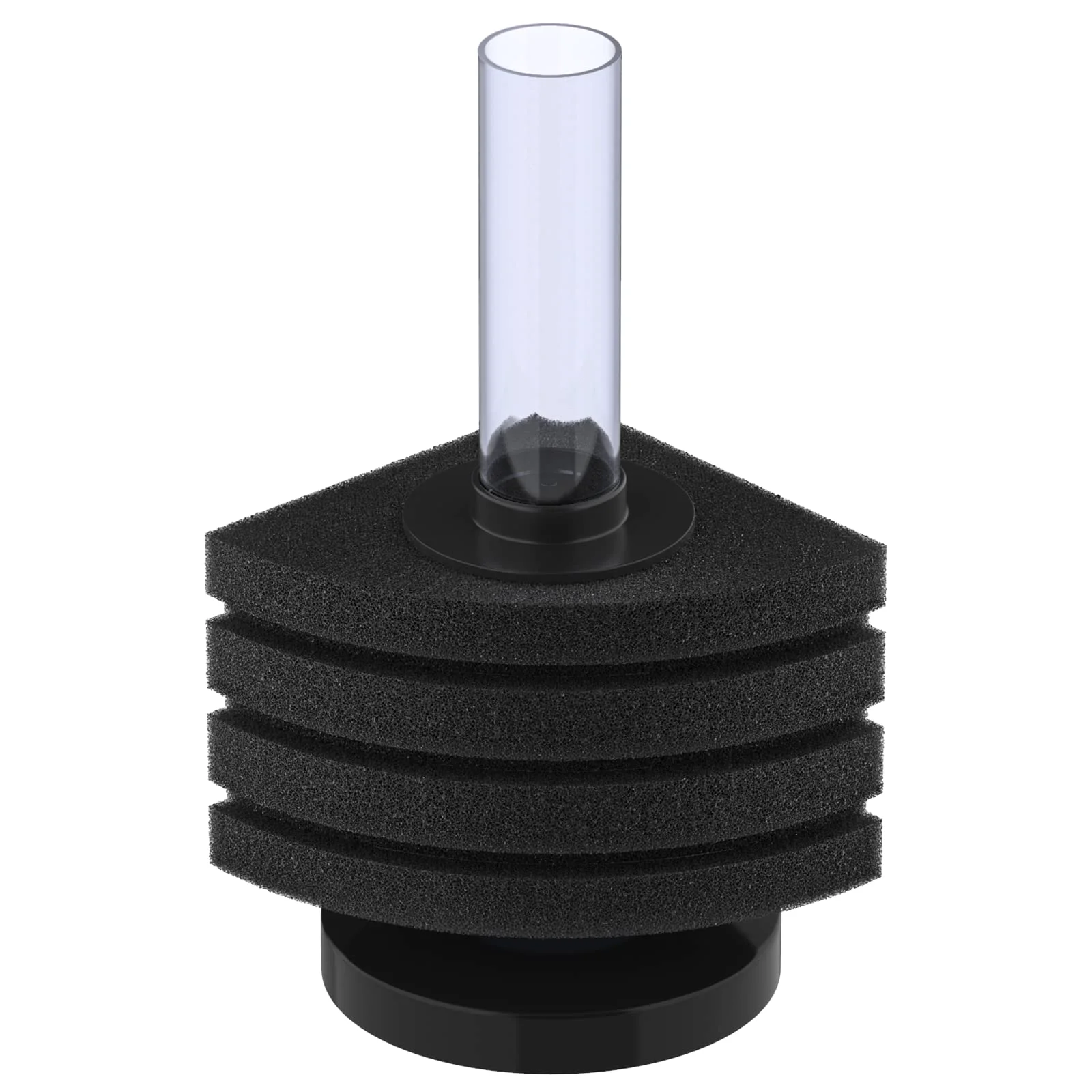
Our sponge filters are sold by tank size, and the size on the option is the one to follow. For a desk tank of 1 to 3 gallons with a single betta or a few shrimp, the Pawfly Nano Bio Sponge Filter starts with a foam 1.5 inches wide. Both the Pawfly Mini Sponge Filter and the Pawfly Corner Sponge Filter start around the 5 to 10 gallon tank, and each comes in larger versions as far as 60 and 50 gallons. Its shape lets the corner model tuck into the back angle of the glass and leave the open water for the fish.
Small tanks deserve the same care as large ones. Habitattitude, a public program on aquarium keeping and invasive species, notes that some smaller tanks cost less up front but need more time and attention to keep water quality right. A sponge rated for your full volume, rather than one size down, gives the bacteria in a small tank more room to settle.
Two of our filters work differently. The Pawfly Mini Internal Sponge Filter is an air-driven internal filter for 5 to 20 gallons with filter balls in its base, and its description asks for an air pump under 4 W. No air pump at all goes with the Pawfly Electric Sponge Filter, 70 GPH. A 3 W motor moves the water, and its S and M sizes cover 10 to 40 and 15 to 55 gallons. All five sit on our sponge filter shelf and on the Pawfly sponge filter page.
| Filter | Tank sizes offered | Size of the smallest version | Runs on | Rinse, as our description states |
|---|---|---|---|---|
| Pawfly Nano Bio Sponge Filter | up to 3 gal to up to 60 gal | 1.5 in wide, 3 in tall (1 to 3 gal) | air pump | every 2 to 4 weeks |
| Pawfly Mini Sponge Filter | up to 3 gal to up to 60 gal | 2 in wide, 4.8 in tall (5 to 10 gal) | air pump | every 2 to 4 weeks |
| Pawfly Corner Sponge Filter | up to 10, 30 or 50 gal | 3.3 in wide, 4.9 in tall (5 to 10 gal) | air pump | every 2 to 4 weeks |
| Pawfly Mini Internal Sponge Filter | 5 to 20 gal | 3.2 in wide, 2.2 in tall | air pump under 4 W | every 2 to 4 weeks |
| Pawfly Electric Sponge Filter, 70 GPH | S 10 to 40 gal, M 15 to 55 gal | 6.2 in wide, 11.2 in tall (S) | built-in 3 W pump | every 2 weeks |
Setting up with an air pump, airline and a check valve
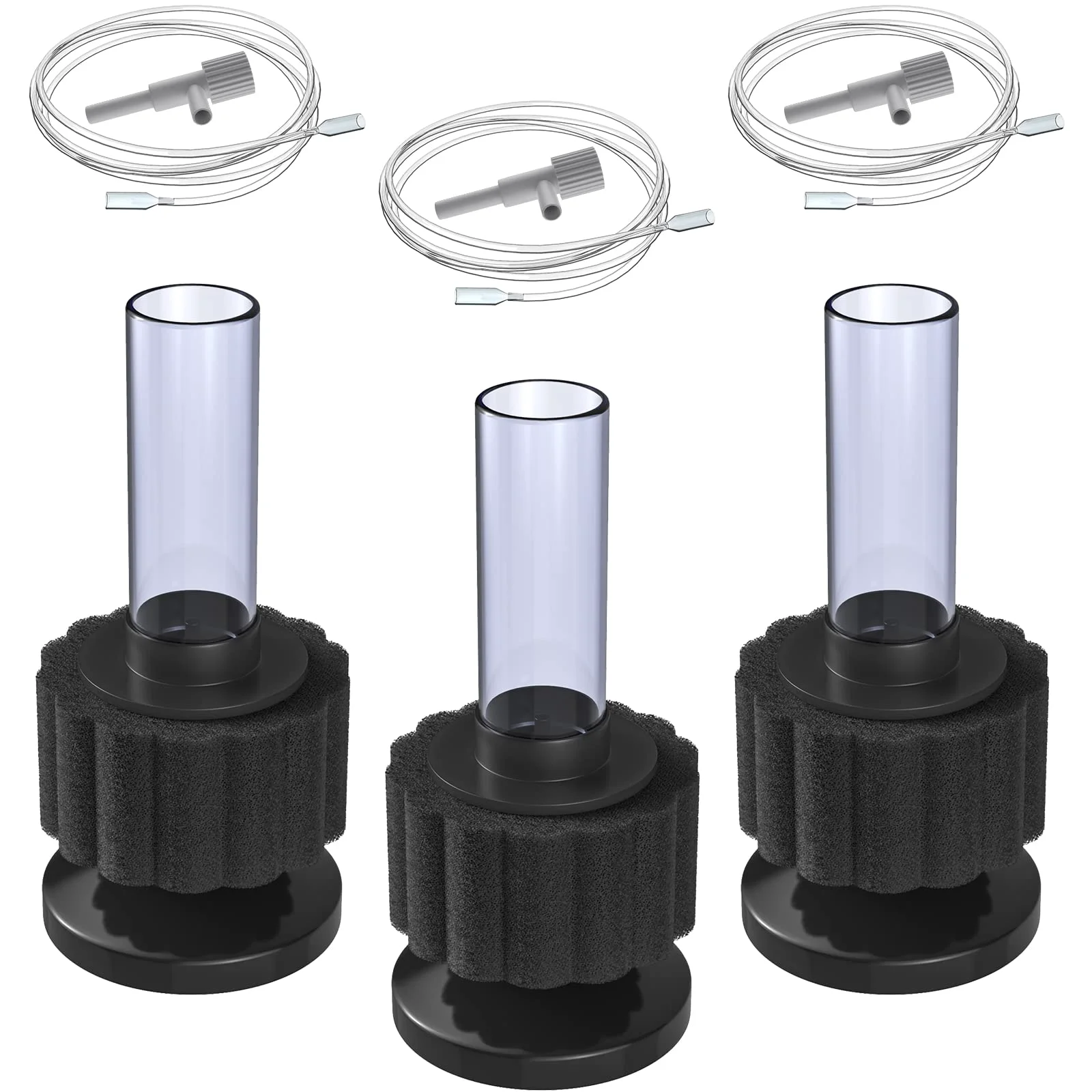
An air-driven sponge filter comes without a pump. The Pawfly Mini Sponge Filter arrives with 6.5 feet of airline, a control valve, four suction cups, a straight and a T connector, and a check valve. Our Nano Bio Sponge Filter brings 3 feet of airline and a control valve, and only its smallest kit adds a check valve. Without one, pick a pack from our airline and valve shelf whenever the pump will stand below the water line.
For the pump, a nano tank pairs well with the Pawfly 1.3 W Nano Air Pump Set, which is also sold with a sponge filter in the box. The Pawfly Compact Air Pump 15 to 40 GPH has a version with a bio sponge filter for 3 to 20 gallons. Larger tanks with two sponges belong on a two-outlet pump from our air pump shelf.
- Hold the sponge under water and squeeze it until no more bubbles come out, so it sinks and sits flat.
- Run airline from the pump to the top of the lift tube, cutting it to length so it does not loop on the floor.
- Fit the check valve so air passes from the pump toward the tank whenever the pump stands lower than the water.
- Set the control valve so the tube gives a steady stream rather than a violent boil.
- Press the suction cups against clean glass and route the line along a corner.
Waiting for the bacteria in a new tank
A brand new sponge is only foam. UF/IFAS Extension says a new biofilter needs six to eight weeks to build up enough bacteria to bring ammonia and nitrite down. During those weeks, the sponge traps debris from day one, but its colony cannot yet keep up with what the fish excrete.
Testing tells you where the tank stands. The extension states that ammonia in a tank should always read zero, that nitrite is toxic to fish at levels as low as 0.10 mg/L, and that ammonia should be tested once a week. Our water test kits cover those readings. If you treat a sick tank, test more often for a while: the same publication warns that some disease treatments, especially antibiotics, can harm the bacteria in the biofilter.
Rinsing a Pawfly sponge filter in tank water, never under the tap
Every one of our air-driven sponges carries the same instruction: rinse it every 2 to 4 weeks in water taken from the aquarium, never in tap water. On the electric model the interval is every 2 weeks, also in tank water only. The reason is in the tap.
UF/IFAS Extension describes chlorine as a very effective sanitizer against algae, bacteria, fungi and some viruses. Almost all US public water systems use it, and many add ammonia to form chloramine, which does not leave water as easily as chlorine alone. Water treated to kill bacteria on its way through the pipes is a poor bath for the colony in your foam. Even a trace of chlorine, the extension notes, can be fatal to fish.
The clean is quick. During a water change, fill a bucket with the water you are taking out, lift the sponge into it and squeeze it a few times until most of the brown cloud is out. Put it back while it is still wet and pour the dirty water away. The aim is a sponge that passes water freely again, not one that looks new.
Replacement sponges and media pads
Foam does not last forever, and spare foam is part of the range. The Pawfly Nano Bio Sponge Filter and the Pawfly Corner Sponge Filter are both sold as a replacement filter on their own. For the Pawfly Mini Internal Sponge Filter there is a pack of replacement sponges, and its description asks you to replace the white sponge every 2 to 3 months.
The bacteria live on the surface of the foam, so a full swap takes the colony out with the old sponge. If your tank runs two sponges, changing them in different weeks leaves one seasoned surface in the water while the new one fills in.
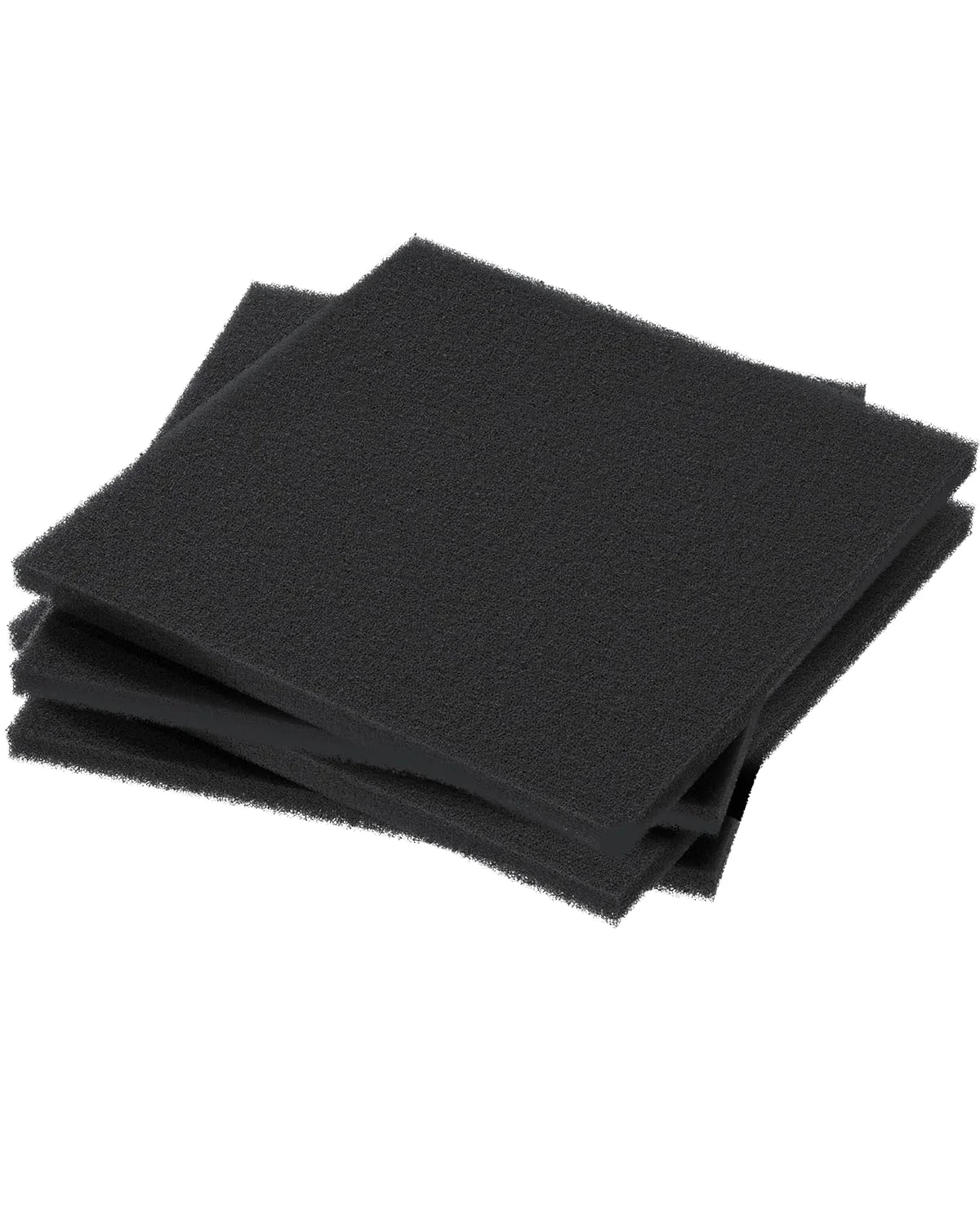
For power filters and sumps, the Pawfly Bio Sponge Filter Pads come at 30 or 40 PPI in packs of 4, 6 or 12. Each pad is 6.3 by 5.5 inches and 0.78 inch thick, and you cut it to the size of the chamber after a rinse in cool water to clear surface dust. The Pawfly Pre-Filter Intake Sponges, in packs of 6, slip over a filter intake so shrimp and fry are not drawn in. Both live on our filter media shelf.
When the bubbles slow down
A sponge that clogs with debris resists the water, and the stream from the lift tube thins out. Usually a squeeze in tank water is all it takes. If the stream stays weak after a rinse, look along the air line instead. Our check valve descriptions ask you to clean the valve and, if it clogs inside, to push it open from the inlet side with a slim stick. Kinked tubing and a control valve turned almost shut cause the same symptom. Small tanks for bettas and shrimp, with the gear sized for them, are gathered on the Pawfly betta and shrimp tank page.
The figures above come from Pawfly aquarium supplies.