


How to size a Pawfly air pump for your tank
The gallon range on the box is a starting point. What your pump really has to do depends on how deep the outlet sits, how many stones and sponge filters share its air, and where the pump stands.
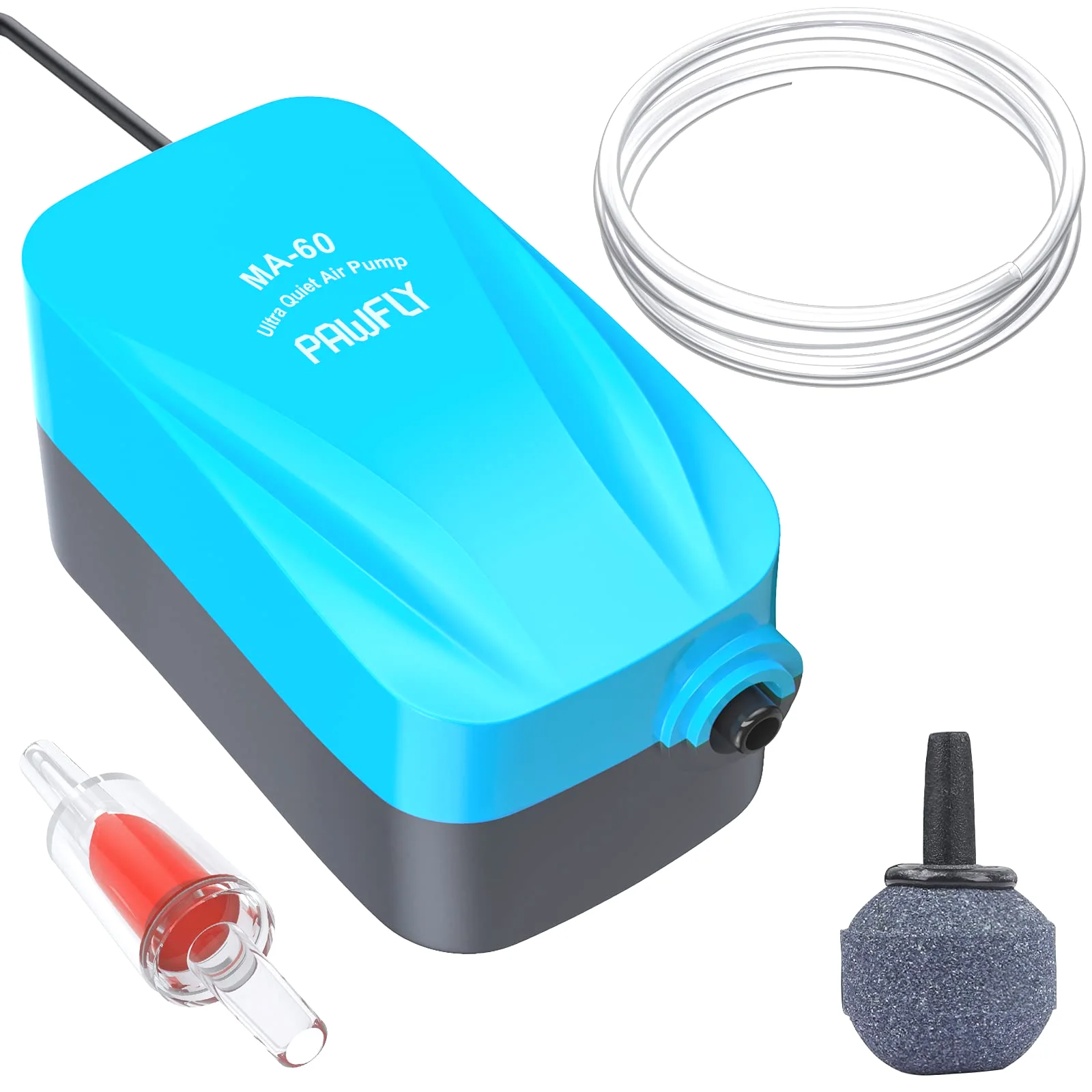
Start with the tank, then count what the pump drives
An air pump never touches the water itself. It pushes air down a 3/16 inch line to an air stone or a sponge filter, and the rising bubbles keep the surface of your tank moving. UF/IFAS Extension names three main sources of oxygen in water: diffusion from the atmosphere, wind and wave action, and photosynthesis. Inside a glass box there is no wind, so the column of bubbles does that work.
Every pump on our air pump shelf carries a gallon range. Treat it as the first filter, not the answer. Three questions settle the rest, and you can answer all of them with a tape measure and a look at the gear already in your cabinet.
- Volume: how many gallons does the tank hold?
- Depth: how far below the surface will the stone or the sponge filter sit?
- Load: how many stones, sponge filters or tanks will share one pump?
Gallons and GPH on a Pawfly air pump
GPH is the most air a pump moves in an hour. The hose, the stone and the water above the stone all take a share of it, so the flow you see in the tank is always lower than the number on the label. That gap is why our pumps are sold by gallon range rather than by GPH alone.
For a small betta or shrimp tank with one stone, the Pawfly 1.3 W Nano Air Pump Set moves 7.1 GPH and is sized for 1 to 15 gallons. The Pawfly Mini Air Pump with Wall Bracket comes in 15 or 50 GPH and covers 3 to 20 gallons. A community tank of up to 60 gallons with two sponge filters needs more air and two lines. That is the job of the Pawfly Dual-Outlet Air Pump 70 GPH or the 5 W version of the Pawfly Adjustable Air Pump 80 GPH. Larger setups and fish rooms move up to the Pawfly 254 GPH Multi-Outlet Air Pump, rated up to 300 gallons. Garden ponds are a different scale again: the Pawfly 500 GPH Pond Air Pump on our pond aeration shelf comes in versions for ponds up to 3,000 or up to 10,000 gallons.
Between two sizes, take the larger one and turn it down. Most of our mains pumps have a knob or a lever valve, and a pump running below its top setting has air in reserve when a stone starts to clog.
| Pump | Flow | Tank size | Outlets or power | Noise |
|---|---|---|---|---|
| Pawfly 1.3 W Nano Air Pump Set | 7.1 GPH | 1 to 15 gal | 1.3 W | about 30 dB |
| Pawfly Mini Air Pump with Wall Bracket | 15 or 50 GPH | 3 to 20 gal | 1 W (15 GPH) | under 35 dB |
| Pawfly Compact Air Pump 15 to 40 GPH | 15 to 40 GPH | 3 to 60 gal | 2 W | under 45 dB |
| Pawfly D-Battery 40 GPH Portable Air Pump | 40 GPH | 5 to 30 gal | 2 D batteries | under 45 dB |
| Pawfly Dual-Outlet Air Pump 70 GPH | 70 GPH | 10 to 200 gal | 2 outlets | under 30 dB |
| Pawfly Adjustable Air Pump 80 GPH | 80 GPH | up to 70 gal (3 W), up to 160 gal (5 W) | 3 W or 5 W | under 35 dB |
| Pawfly 254 GPH Multi-Outlet Air Pump | 254 GPH | up to 300 gal | 4 outlets, 7 W | under 45 dB |
Water depth: why a tall tank asks for a stronger pump
Air leaving a stone has to push aside all the water stacked above it. The deeper the stone, the harder the water pushes back. A small pump that bubbles hard just under the surface can fade to a trickle at the bottom of a tall column tank, even though the gallon count is well inside its range.
The figure that tells you how much depth a pump can handle is its pressure, printed in MPa on our product pages. Nano tanks and shallow buckets suit the Pawfly Mini Air Pump with Wall Bracket at 0.01 MPa and the Pawfly Compact Air Pump at 0.012 MPa. Our Portable Live Bait Pump and both rechargeable bait aerators are rated at 0.015 MPa or more. Further up, the Pawfly Adjustable Air Pump 80 GPH reaches 0.02 MPa or more, the Pawfly 120 GPH Pond Aeration Kit 0.024 MPa and the Pawfly 254 GPH Multi-Outlet Air Pump 0.025 MPa. At the top, the Pawfly 500 GPH Pond Air Pump is rated at 0.032 MPa.
The stone matters as much as the depth. Fine pores make finer bubbles and also resist the air more, so a dense disc needs a stronger pump than a coarse cylinder. Our air stones each carry a recommended pump power, gathered in the table below. When a stone you just lowered gives off fewer bubbles than it did at the surface, the pump has reached its limit at that depth.
| Air stone | Recommended pump power |
|---|---|
| Pawfly Mini Air Stones, Multi-Pack | 2 to 4 W |
| Pawfly Air Stone Disc 1.5 Inch | 2 to 4 W |
| Pawfly Nano Bubble Air Stone Disc | more than 2 W |
| Pawfly Air Stone Bar Bubbler | more than 2.5 W |
| Pawfly Air Stone Ball 2 Inch | more than 4 W |
| Pawfly Hemispherical Air Stone Disc | more than 4 W |
| Pawfly Air Stone Disc with Suction Cups | more than 4 W |
| Pawfly Large Air Stone Cylinders 4 x 2 Inch | more than 7 W |
| Pawfly Long Air Stone Cylinder | more than 7 W |
| Pawfly Bread Air Stone | more than 20 W |
Running several stones or sponge filters from one Pawfly pump
Every device you add splits the same flow. UF/IFAS Extension points out that a multiport gang valve lets one air pump run several airstones, and that is how most fish rooms work: one pump, one main line, a valve on every branch.
Some of our pumps arrive ready to split. The Pawfly Dual-Outlet Air Pump 70 GPH and the Pawfly 120 GPH Pond Aeration Kit have two outlets, and the Pawfly 254 GPH Multi-Outlet Air Pump ships with a four-outlet copper distributor. A single-outlet pump can feed more lines through the T connectors in the Pawfly Airline Connector Kit or through the Pawfly Multi-Way Air Manifold. The manifold takes a 3/8 inch inlet and gives six or eight 3/16 inch outputs.
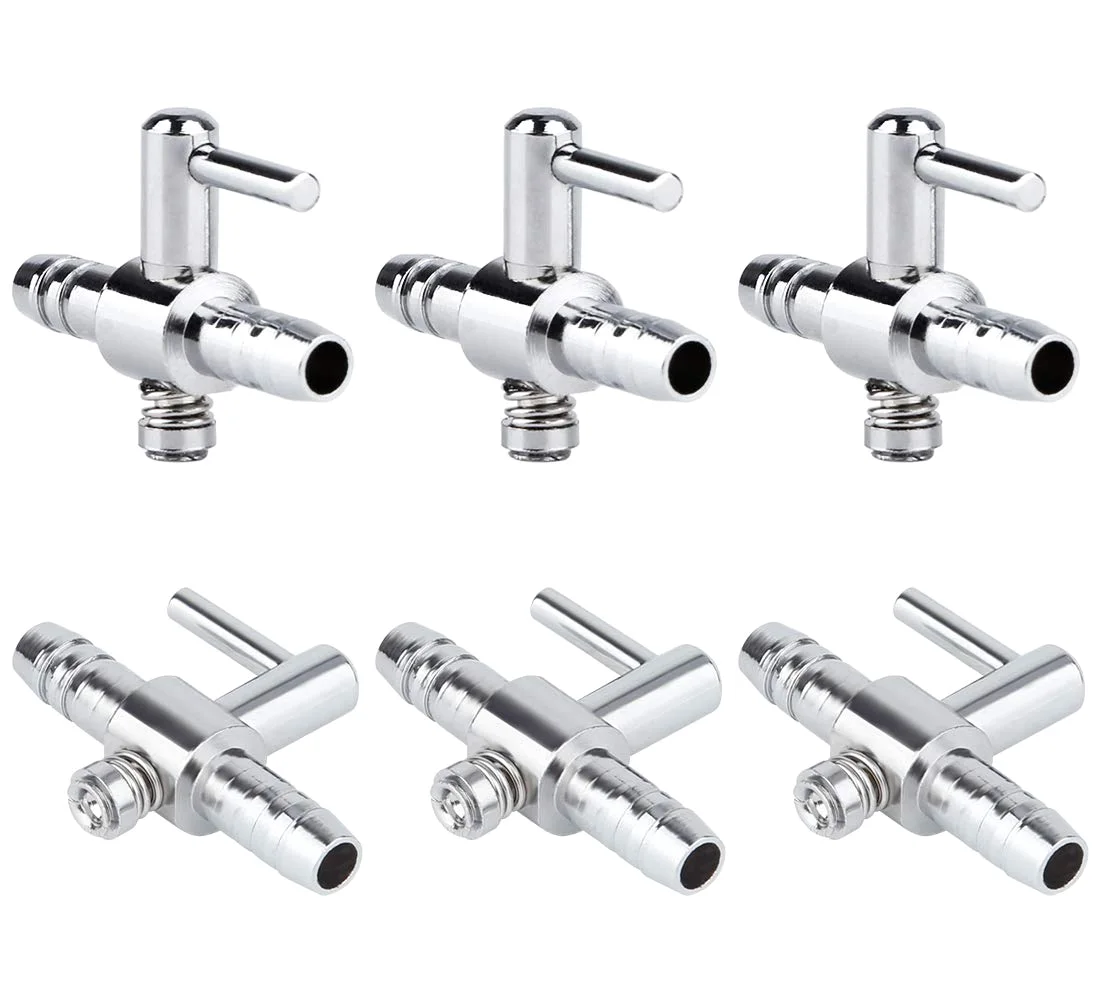
Valves matter because air always takes the easiest path. A line to a shallow stone will steal air from a sponge filter sitting at the bottom, and without a valve the deep device starves. Fit a lever on each branch and close down the greedy line until both bubble evenly. The Pawfly Metal Single-Way Lever Valves come in versions from one to eight ways. For a tidy rack of tanks, the Pawfly Threaded Metal Air Control Valves screw into a rigid pipe after a pilot hole drilled with a 13/64 inch bit.
- The pump, followed by a check valve if it sits low.
- A manifold or T connectors to split the main line.
- One lever or knob valve on every branch.
- At the end of each line, the stone or sponge filter.
Where the pump stands, and when a check valve goes in the line
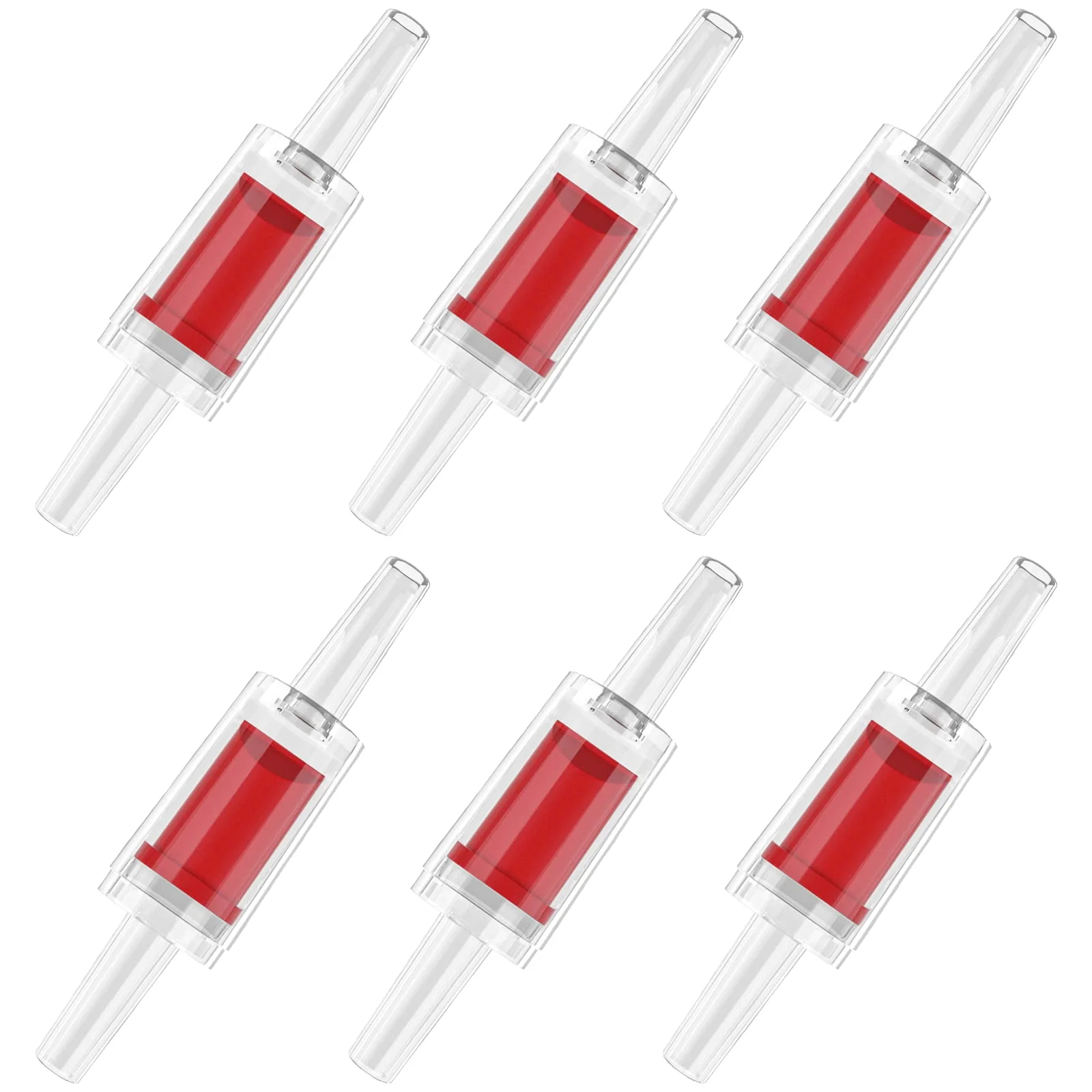
When the power cuts out, the pump stops pushing and the water in the airline is free to run backward. A pump standing on the floor below the water line can siphon tank water down the hose and into its own body. The Pawfly Aquarium Check Valves are one-way valves that block that backflow during an outage or a pause. They are made for air pumps only and are not meant for CO2 or other high-pressure systems.
Fit the valve so air passes from the pump toward the tank. If the flow slows over the months, poke the valve open from its inlet side with a slim stick. Several of our pumps include one already: the Pawfly Compact Air Pump, the Pawfly Mini Air Pump with Wall Bracket and the Pawfly 1.3 W Nano Air Pump Set. Our Dual-Outlet Air Pump 70 GPH includes two.
Height is the other answer. The Pawfly Mini Air Pump with Wall Bracket clamps to the tank wall, and the nano pump clips to the rim or sticks to the outside glass, so both stand above the water. UF/IFAS Extension adds one more rule for any air pump near a tank: place it where it cannot fall into the water. Spare valves, tubing and connectors live on our airline and valve shelf.
A Pawfly battery air pump for power outages
An outage stops every plug-in pump at once. UF/IFAS Extension recommends 5 mg/L of dissolved oxygen or more and notes that most fish species are distressed when it falls to 2 to 4 mg/L. When fish are struggling for oxygen, it says the most important step is to turn on an aerator. A pump that does not need the wall socket covers that gap.
The Pawfly D-Battery 40 GPH Portable Air Pump runs on two D batteries, which are not included, and is sized for 5 to 30 gallons. A small air stone and two feet of tubing are stored inside its body, and a metal clip holds it on a tank rim or bucket. Keep fresh batteries in the same drawer so it is ready on the night you need it.
For a tank that should never go without air, the Pawfly Rechargeable Live Bait Aerator works on both mains and battery. While it is plugged in, it runs from the socket. When the power fails, its built-in 2200 mAh battery takes over by itself, and our product description states 24 to 30 hours in normal mode. More battery models are gathered on the Pawfly battery air pump page.
Noise, and a quick sizing checklist
A pump in a bedroom or an office is heard every night. Our two quietest aquarium pumps, the Pawfly 1.3 W Nano Air Pump Set and the Pawfly Dual-Outlet Air Pump 70 GPH, are rated at 30 dB or less. The Mini and the Adjustable come in under 35 dB, the Compact and the 254 GPH pump under 45 dB. A bare cabinet floor can drum along with a pump, so set it on its rubber feet on a folded towel. Low-noise models from every shelf share one page, Pawfly quiet air pumps, and the tank planner pairs pumps, filters and lights by tank size.
- Match the gallon range first, then pick the larger size if you are between two.
- For deep tanks and dense stones, compare pressure in MPa as well as GPH.
- Count every stone and sponge filter, and give each branch its own valve.
- Fit a check valve whenever the pump stands below the water line.
- Keep a battery pump and spare batteries for the night the power goes out.
The figures above come from the Pawfly catalog.